
Air source heat pump installations may often be led by heating engineers, but electricians are also an important part of the installation. Rob Dyer, Technical Sales Support Engineer at Grant UK for the East of England and Midlands, outlines what you need to know when working with heat pumps.
Air source heat pumps (ASHPs) are no longer a niche technology: they’re at the heart of the UK’s drive towards low-carbon heating. By extracting heat energy from the air outside and raising it to a higher temperature for use in a wet heating system, heat pumps are already helping thousands of homes cut carbon emissions and reduce reliance on fossil fuels.
The electrician’s role
Typically, electricians are brought into a heat pump installation once the main components are in place. Their responsibilities can be divided into two core tasks: providing a circuit for the heat pump unit itself (a suitably sized supply cable is needed which, for most heat pumps, will be 16 A to 32 A) and connecting the controls and wiring centre.
Because the heat pump itself is always located outside, it must be wired to the equipment indoors (this often involves a modBus data connection or other wiring).
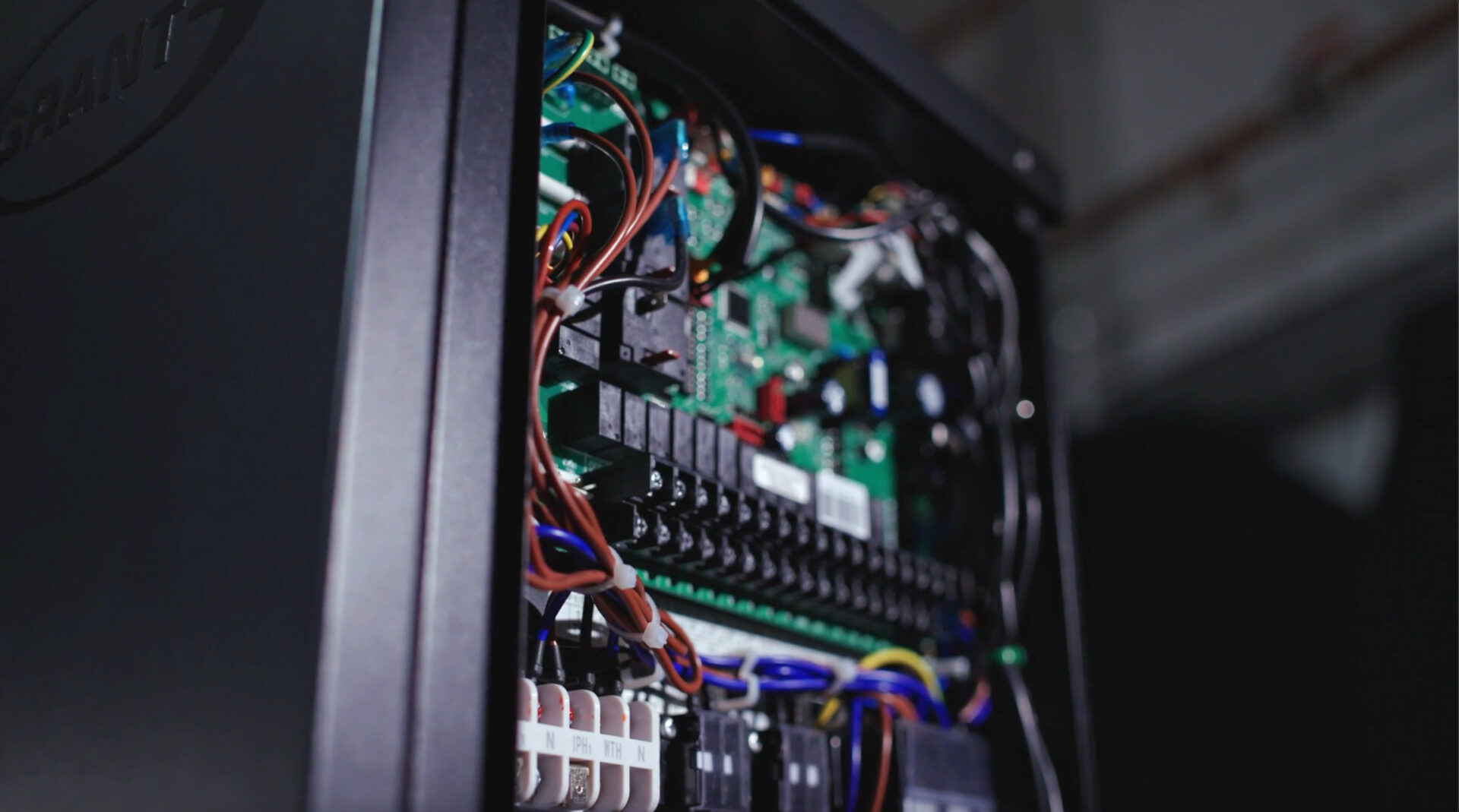
The wiring centre is also indoors, which any valves, pumps, cylinder and thermostats might need to be wired into. For those familiar with traditional heating systems, this part won’t feel alien: most heat pump systems are similar to a W-plan configuration so if you understand Y-plan or S-plan wiring, you’ll quickly grasp a W-plan which uses a 3-port diverter valve instead of 2-port valves or a 3-port mid-position valve.
The heart of the system
The controller is the window into the entire heating system, giving engineers and homeowners visibility of the system’s operation and managing most of the components including pumps, valves and thermostat settings.
Correct set-up is really important; issues that tend to arise with heat pumps don’t usually stem from faulty components but from a misconfigured controller.
Electricians working on these systems need to understand how to programme and troubleshoot controllers to ensure they are set correctly and for best efficiency.
All Grant heat pumps come with manuals that include an electrical section with clear instructions for those responsible for completing the electrical connections and set-up.
Electricians will, for example, find clear guidance on what size of power supply cable they need for the specific heat pump model being installed, as well the breaker capacity, MCB size and RCD requirements.
Grant’s Aerona Smart Controller is also intuitive to set up, with clear questions to guide electricians and installers. Once complete, the screen can be used to verify wiring and test component functions.
Questions answered
A common misconception is that a 10 kW heat pump requires a 50 A supply – 10 kW refers to the unit’s heating output, not its electrical demand and misunderstanding this can mean the difference between specifying a 2.5 mm cable and a 10 mm cable.
Electricians also need to understand clearances and specifically protective zones – different heat pump models have specific installation rules. For example, R290 heat pumps have defined safety zones around the outdoor unit, meaning any electrical items such as lights, sockets, switches or isolators cannot be installed in those areas.
In addition, before any installation, either the installer or the electrician must confirm with the Distribution Network Operator (DNO) that the property’s supply can handle the additional load of a heat pump. Skipping this step could cause problems down the line. This step is now made simple by using the ENA ‘Connect Direct’ website.
Only qualified electricians should undertake heat pump electrical connections because all work should be tested and certificated, as the majority of the time a new circuit has to be installed, with formal sign-off required for Building Control.
Membership of a Competent Persons Scheme such as NICEIC or NAPIT is strongly advised. Beyond the paperwork, knowledge of heating system wiring is invaluable and understanding hydronics and plumbing will help too.
Learning the right skills
Heat pumps may be the future of home heating, but they depend on skilled electricians to help make them work. With the right training, resources and manufacturer support, electricians can confidently expand into this growing field, helping homes decarbonise while adding a valuable new string to their professional bow.
To support electricians, the Grant UK Training Academy offers dedicated sessions on wiring as part of both the Aerona³ ASHP Installer Course and the Aerona 290 ASHP Installer Course.
Get more details on Grant UK’s heat pump technology and supporting training courses here
Find more industry features here