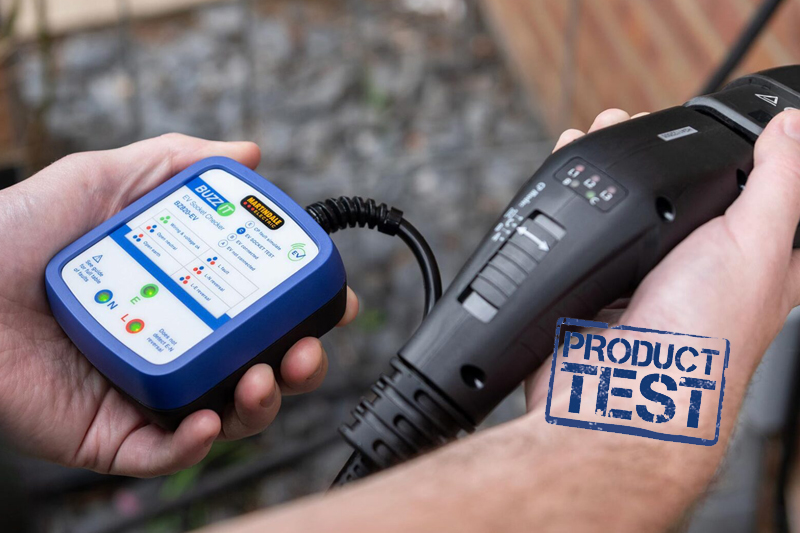
Adam Stears of Sota Electrical is in the product testing hot-seat this month as he puts Martindale Electric’s BZ820-EV socket tester through its paces.
EV charge point installations are quickly becoming an everyday part of an electrician’s workload, so the need for quick, reliable and job-specific test equipment is only increasing.
Whether you’re installing a new EVSE, carrying out periodic maintenance, or responding to call-outs where the history of the installation is unclear, having the right tester to hand can save time and avoid unnecessary headaches.
With that in mind, I’ve been using Martindale Electric’s new BZ820-EV EVSE socket tester for the past few weeks to see how it performs in real-world conditions.
Initial thoughts
Martindale Electric has built a solid reputation over the years for robust, no-nonsense testing equipment that’s designed and supported here in the UK.
The BZ820-EV is billed as the first of its kind EVSE socket tester, specifically aimed at Type-2 EV charge points, and designed as a first-line functional checker rather than a replacement for full installation testing.
The unit feels well-made and reassuringly solid without being bulky. It’s clearly intended to live in your trusty tester bag and be pulled out regularly, rather than being a delicate bit of kit you worry about on-site.
The integral Type-2 connector plugs straight into the EVSE charging point, which immediately makes it feel purpose-built rather than adapted from something else.
How did it perform?
In use, the tester proved to be quick and straightforward. On initial checks, it allowed me to rapidly confirm the presence of supply and basic wiring conditions at the charger.
For anyone carrying out fault-finding or attending existing installations where you don’t know who installed it or what condition it’s in, that’s a big plus. Being able to identify potential issues early on, before committing to more involved testing, can save a lot of time.
The BZ820-EV is capable of detecting 28 different wiring fault conditions, which is impressive for a first-line tester. Voltage supply is also checked and indicated as either high or low, adding another useful layer of information straight away.
Correct polarity is shown clearly by three flashing green LEDs accompanied by a continuous audible tone. Fault conditions, on the other hand, are hard to miss, with three red LEDs and an intermittent warning buzzer. There’s no ambiguity here – you know very quickly whether things look healthy or not.
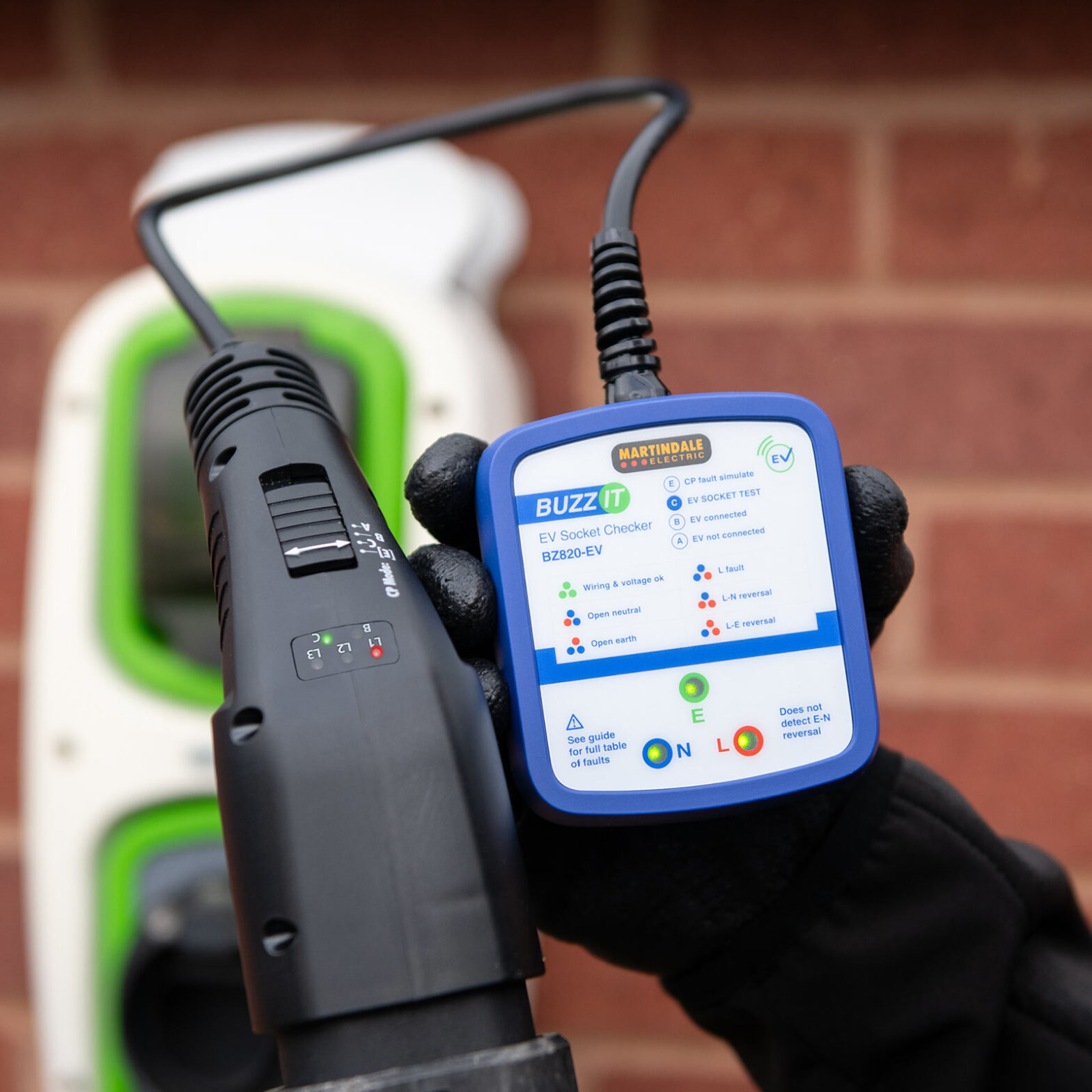
Socket polarity and earth wiring faults are indicated by combinations of red LEDs, and Martindale has included a simple look-up chart on the tester itself to help with basic fault diagnosis. That’s a nice touch, particularly when you’re on-site and don’t want to be digging through manuals or searching online.
One of the standout features is the integral CP mode 4-position slider switch. This allows you to simulate different vehicle states: no vehicle connected (Mode A), vehicle connected but not ready to charge (Mode B), vehicle connected and ready to charge (Test Mode C), and an additional “E” error setting.
The error mode simulates a failure of the CP signal, forcing the charger to inhibit charging. This is particularly useful when checking how the charger behaves under fault conditions and adds real practical value during commissioning and troubleshooting.
There are also LEDs built into the Type-2 plug itself, showing CP signal status and whether the voltage supply is present on L1. Alongside this, the tester provides fast confirmation of correct L, N and PE wiring in a three-wire cable. All the indications are clear and easy to interpret, even in less-than-ideal lighting conditions.
A great starting point
Over the time I’ve been using it, the BZ820-EV has proven itself as a practical and well thought-out tool. It’s not designed to replace formal testing procedures, and it doesn’t pretend to. Instead, it sits exactly where it should – as a valuable preliminary check that provides added confidence before commissioning or further investigation. For initial checks, fault-finding, and routine maintenance, it does exactly what you’d want it to do.
The tester is suitable for indoor and outdoor use, although it’s worth noting it’s intended for dry conditions only. That’s fairly standard for this type of equipment, but still something to be aware of.
Overall, Martindale has produced a sensible, purpose-built tester that will appeal to electricians working with EV charge points on a regular basis.
It’s quick to use, provides clear feedback, and fits neatly into existing testing routines without overcomplicating things.
For contractors and installers looking for a reliable first-line EVSE checker, the BZ820-EV is a worthwhile addition to the kit bag.
Get more details on the Martindale Electric BZ820-EV here
Find more product tests and reviews here