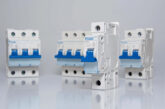

Hager’s Technical Training Manager, Paul Chaffers, discusses pollution degree classifications of circuit-breakers, considering the effects of external influences associated with outdoor installations.
Pollution degrees help manufacturers and designers select appropriate circuit-breakers and enclosure designs based on the operating environment inside the enclosure. The presence of dust, moisture, or conductive particles can significantly degrade insulation performance, especially in ventilated or outdoor installations.
What is pollution degree?
Pollution degree (PD) is a classification defined by standards such as IEC 60664 (Insulation coordination for equipment within low-voltage supply systems: Principles, requirements, and tests) and referenced in BS EN IEC 61439 (Low-voltage switchgear and controlgear assemblies) and in circuit-breaker product standards BS EN 60898 and 60947-2.
It describes the expected level of environmental contamination that could Fig 1. Pollution Degree Classifications affect the dielectric strength of insulation within electrical enclosures.
This classification is critical for determining clearance and creepage distances, which are essential for ensuring safe operation and preventing insulation failure.
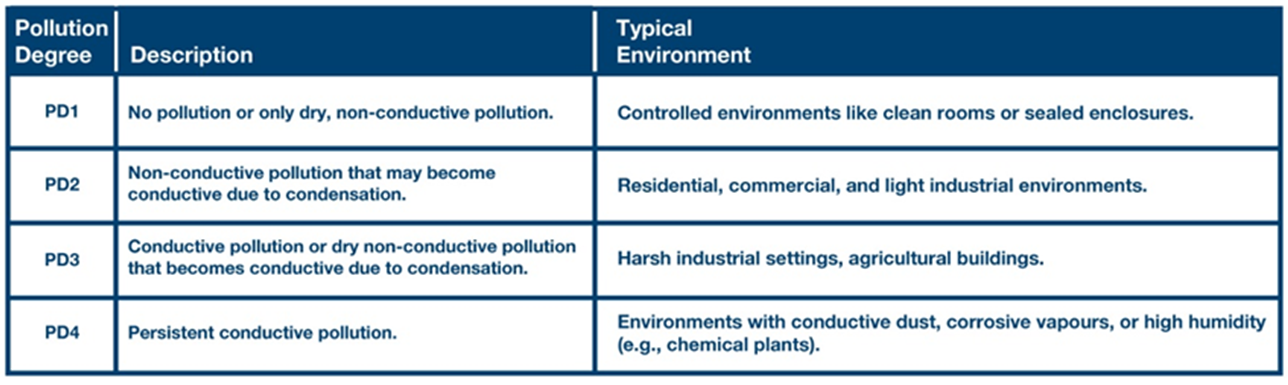
See Fig 1 for a better understanding of each category.
BS EN IEC 61439 sets out the requirements for low-voltage switchgear and controlgear assemblies and mandates that the pollution degree of the internal environment must match the insulation requirements of the components used.
For example, if internal components are rated for PD2 conditions, but the enclosure is installed in an environment where non-conductive pollution may become conductive due to condensation, the risk of dielectric breakdown increases.
This scenario requires careful design consideration, using measures such as:
- Use of filters or sealed compartments to limit ingress of contaminants
- Heaters or ventilation systems to prevent condensation
- Upgrading internal components to withstand PD3 conditions (if appropriate to the installation type)
Circuit-breakers to BS EN 60898
BS EN 60898 is the British Standard for low-voltage circuit-breakers for overcurrent protection in household and similar installations.
It states that circuit-breakers to BS EN 60898 are intended for use in environments with PD2 conditions but allows for installation in environments with a higher pollution degree, provided enclosures offering the appropriate degree of protection are used.
Circuit-breakers to BS EN IEC 60947-2
BS EN IEC 60947-2 is the British Standard for low-voltage circuit-breakers used in industrial, large commercial, and similar installations. It states that, unless otherwise specified by the manufacturer, a circuit-breaker is intended for installation under environmental conditions classified as PD3.
Environmental conditions
In many applications, ventilation is key to the effective operation of enclosed equipment, especially where heat is generated. It helps maintain performance by keeping internal temperatures within design limits.
To reduce enclosure size and cost, natural ventilation using louvres, slots, or vents is commonly used (see Fig 2). When properly positioned, these features can protect against dust and occasional dripping condensate and can be of any length, provided they meet test standards. Ventilation also helps reduce internal condensation caused by temperature and humidity changes.
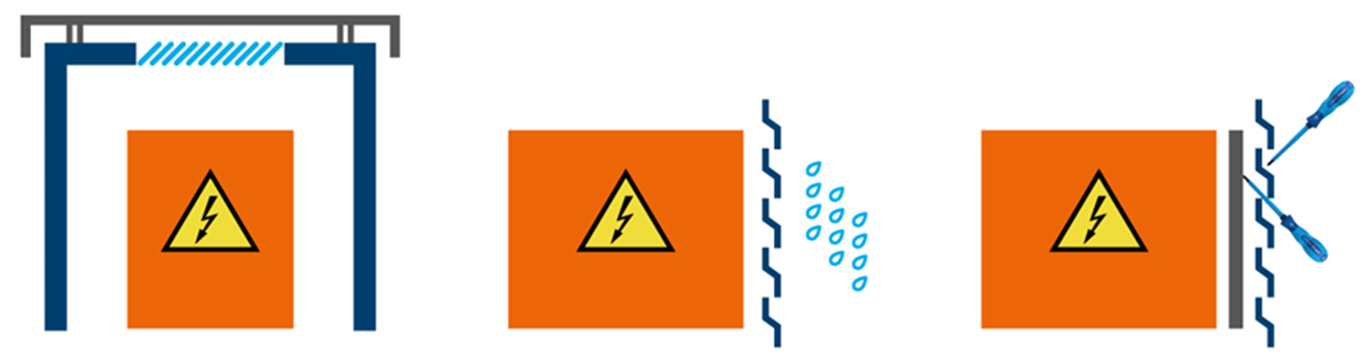
However, it is important to note that ventilated enclosures do not fully isolate the internal environment from the external one. Therefore, pollution degree categories must be considered.
BS EN IEC 61439-1 refers to pollution degrees in relation to environmental conditions, including relative humidity and condensation. It highlights that the pollution degree to which devices and components are exposed inside the assembly enclosure (the micro- environment) may differ from that outside the enclosure (the macro- environment).
This difference is due to protection offered by enclosures with specific IP ratings, ventilation, internal heating, or other methods.
Outdoor applications
For large commercial and industrial outdoor installations, circuit-breakers Fig 2. Ventilated equipment conforming to BS EN IEC 60947-2 are recognised as suitable for PD3 conditions (environments where condensation and conductive pollution are expected). This makes them ideal for outdoor use in these settings. However, these devices are intended to be operated only by instructed or skilled persons.
In residential applications, there is a limitation: BS EN IEC 60947-2 circuit- breakers are not suitable because they are not designed for operation by ordinary persons. Instead, circuit- breakers to BS EN 60898 must be used in domestic settings.
While this standard is based on PD2 conditions (where only non-conductive pollution occurs), it does acknowledge that temporary conductivity, such as that caused by condensation, may occasionally be expected.
Therefore, installers should not be concerned about using BS EN 60898 circuit-breakers in outdoor enclosures, provided the manufacturer has tested and validated the assembly arrangement as suitable for such use.
In addition to standard switchgear assembly tests such as short-circuit and temperature rise testing, Hager carry out a range of additional tests which exceed the minimum requirements, including condensation and freeze testing. This is to ensure compliance under extreme weather conditions.
The enclosure’s intended application, as specified and approved by the original manufacturer, must be clearly documented. For example, a general designation such as ‘Outdoor’ suggests suitability for typical outdoor environments. However, if there are specific limitations, these must be explicitly stated, for instance, ‘Outdoor use without direct exposure to sunlight’.
Conclusion
Specifying switchgear and controlgear assemblies for outdoor applications can be a complex task, often accompanied by understandable hesitation due to the need to meet a number of stringent standards.
Installers should be aware that when an empty enclosure is purchased and populated independently, the responsibility for compliance with BS EN IEC 61439 shifts to the installer (who is now the assembly manufacturer with the corresponding obligations). This includes ensuring the assembly meets all relevant performance and safety requirements.
One effective way to mitigate this risk is by selecting equipment that has been tested and validated for outdoor conditions, including features such as relative humidity and condensation control. Doing so not only simplifies compliance but also enhances reliability and long-term performance in challenging environments.
Explore flexible CPD with Hager Academy
Looking to deepen your understanding of outdoor enclosures and related design challenges? The Hager Academy is an online learning platform designed for flexible, CPD-accredited courses.
Our latest course, “Design Considerations for Outdoor Enclosures,” expands our comprehensive suite of training modules, covering key topics such as renewables, EV charging, and solar PV.
Get more details about the course and Hager’s full training offering here
Find more industry technical articles here