Are you getting colour mismatches with your chosen LEDs? In this article the experts at ROBUS tell us more about the principles behind MacAdam ellipse and what it means for lighting.
“Red wire or blue wire?? Red or blue?!” We’ve all seen the movie moment. Not exactly everyday life for UK electricians (“Brown or blue?!” doesn’t have quite the same ring to it), but there’s no denying it: being able to identify colours correctly is a critical skill.
However, for this article, we’re interested in the colour difference between LEDs rather than wires…
Turns out, we’re all a bit colour blind
Is there anything more frustrating than spotting mismatched colours in a design? In the 1940s, physicist David MacAdam – working at Kodak’s research lab – was likely driven by a similar frustration when he began studying how well the human eye can distinguish between different colours.
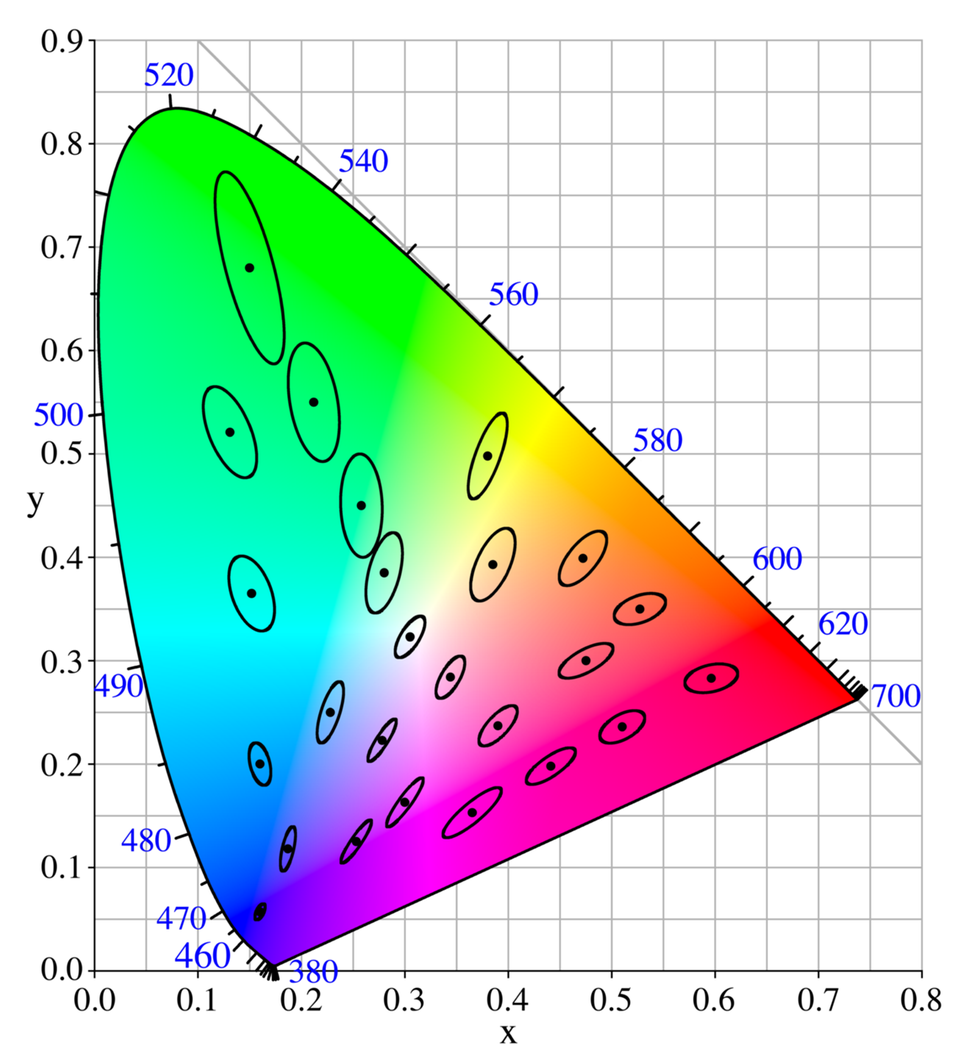
We all like to think we have perfect vision that would catch even the slightest difference in shade, but MacAdam proved that there are “invisible zones” – ellipses between colours that the human eye cannot detect. This is where the term MacAdam ellipse (also called MacAdam Step and SDCM) comes from. So, what does that mean for lighting?
Key takeaway: MacAdam ellipses are areas on a chromaticity diagram where colour differences are so small that most people can’t tell them apart.
Welcome to Standard Deviation Colour Matching (SDCM)
Working out whether two LEDs will match is not as straightforward as it sounds. Even in a single batch of LEDs, colour deviations can occur due to manufacturing tolerances. This is measured with the MacAdam ellipses.
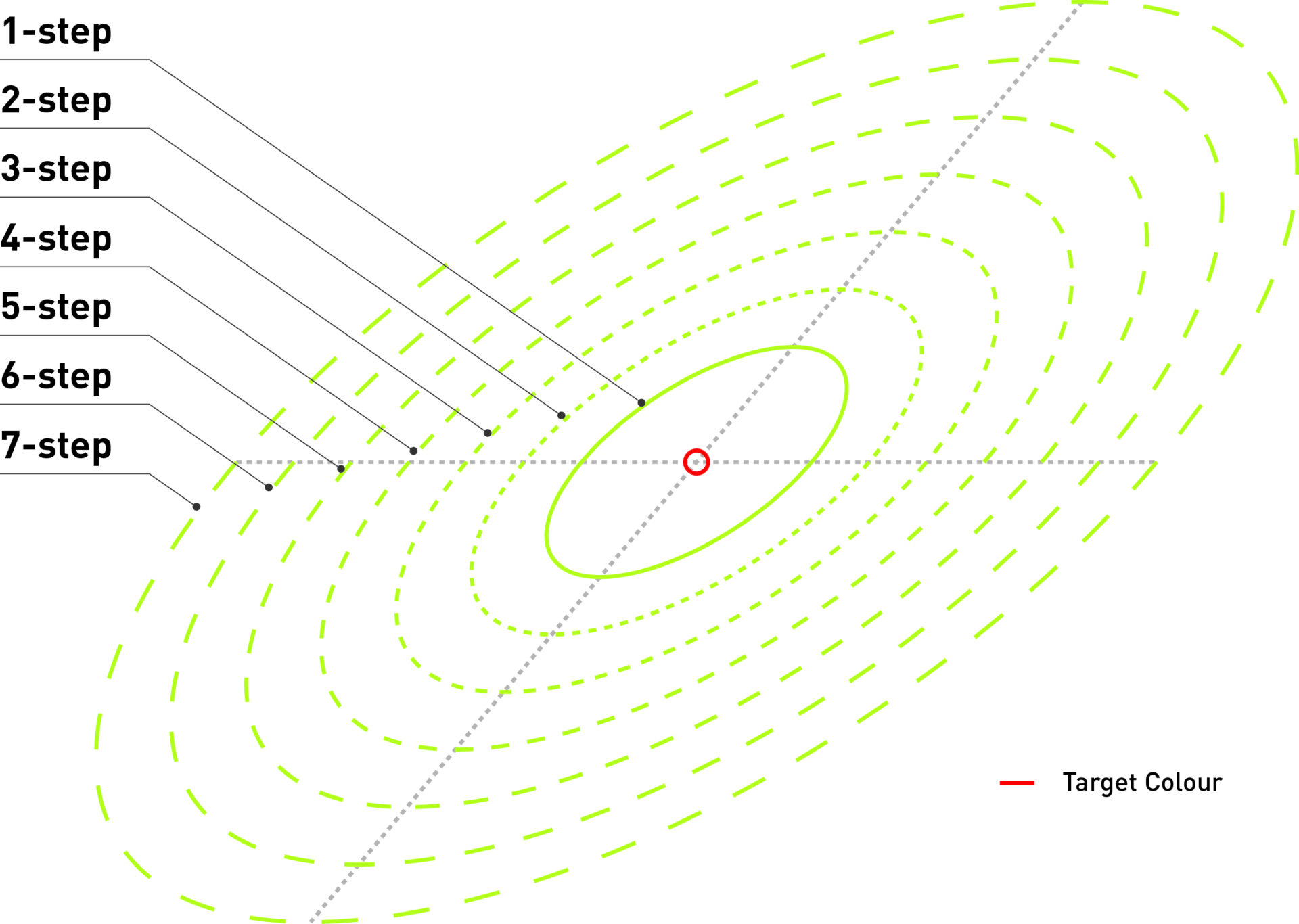
A five-step MacAdam ellipse usually covers most LEDs in a batch, but some may still fall outside this range. LEDs can also shift in colour as they age, which is why it’s important to choose high-quality, well-matched LEDs from the start.
Key takeaway: Most LEDs in a batch fall within a five-step ellipse, indicating standard colour variations allowable while ensuring quality.
Colour consistency starts in the manufacturing process
The process of manufacturing high-quality LEDs is designed to minimise colour variation from the very beginning. The first step in LED production is epitaxial growth, the process of layering semiconductor materials onto a base (substrate) to create the LED chip.
This happens inside a reactor chamber – a tightly controlled environment where precision is critical. Key conditions include:
- Temperature – Must be carefully maintained to ensure even layer formation.
- Gas flow – Regulated to support accurate semiconductor growth.
- Substrate quality – A clean, high-quality base is essential for optimal LED performance.
By tightly controlling these variables, manufacturers produce chips that meet strict performance and colour standards, reducing variation before the LEDs even leave the lab.
Key takeaway: Achieving colour consistency starts at chip level, but only a trusted manufacturer with tight quality control at every stage can deliver LEDs that perform reliably batch after batch.
LED binning: The key to colour consistency
After production, LEDs are sorted through a process called binning, which groups them by key performance traits like brightness and colour temperature.
Why it matters
Without binning, slight manufacturing variations could lead to visibly mismatched lighting in the final installation.
Enter MacAdam ellipses
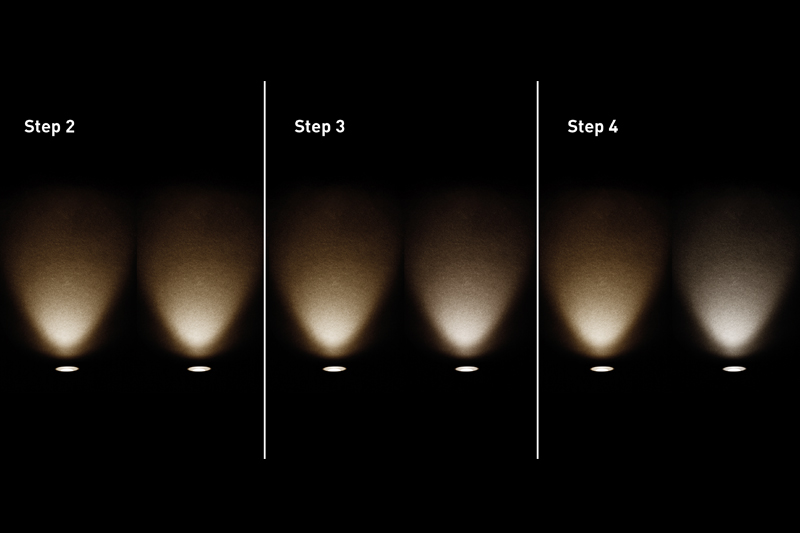
These zones on a chromaticity diagram define how much colour variation the human eye can detect. Tighter bins (like 3-step MacAdam ellipses) mean near-identical LEDs.
Cost vs. accuracy
Manufacturers must choose bins that balance colour precision with production efficiency. The tighter the bin, the more consistent the light, but also the higher the cost.

Not all SDCM is created equal
Single-chip fittings, like COB downlights, need tighter SDCM. Why? Because there’s no hiding place. One LED, one beam, one colour. If it shifts, you’ll see it. But multi-chip fittings (strips, arrays, clusters) are different. The eye blends the light from multiple sources, so minor colour differences average out. A slightly higher SDCM can still look consistent.
Selectable or tuneable CCT adds another layer. Manufacturers often quote 1–3 SDCM, and that’s true when each LED channel is powered individually. But once power is spread across two different LED arrays, blending their colours to produce a third colour, tolerances stack up.
Thermal shifts, driver variation, optics – it all adds up. This can create a colour deviance which when tested would be representing a higher SDCM, often =<6.
Key takeaway: If absolute uniformity is critical (high-end office spaces, premium commercial installs, etc.), stick with fixed CCT and tight binning.
ROBUS prioritises high-quality LEDs so customers can trust that what they install today will still match tomorrow, across every batch.
Browse or download the 2026 ROBUS Lighting catalogue here
Find more industry technical articles here